Gravehoard app icon
Gravehoard · Beta for iPhone, iPad & Mac

An old-school roguelike that plays in one hand.

Gravehoard is a turn-based fantasy roguelike for iPhone, iPad, and Mac: the depth of the games that ran in a terminal, without having to memorize a fifty-key command list first. Make a character, walk down into a procedurally generated barrow, and haul out treasure you don't understand yet — then spend it in the town at the top and go back down better armed. Twenty floors down there's a crown nobody has ever carried out.

Everything buried wants to stay that way.

Join the waitlist.

The list is how you get into the beta. Gravehoard is in beta now on TestFlight, for iPhone, iPad, and Mac. Confirm your email to finish — unsubscribe anytime, see our Privacy Policy for details.

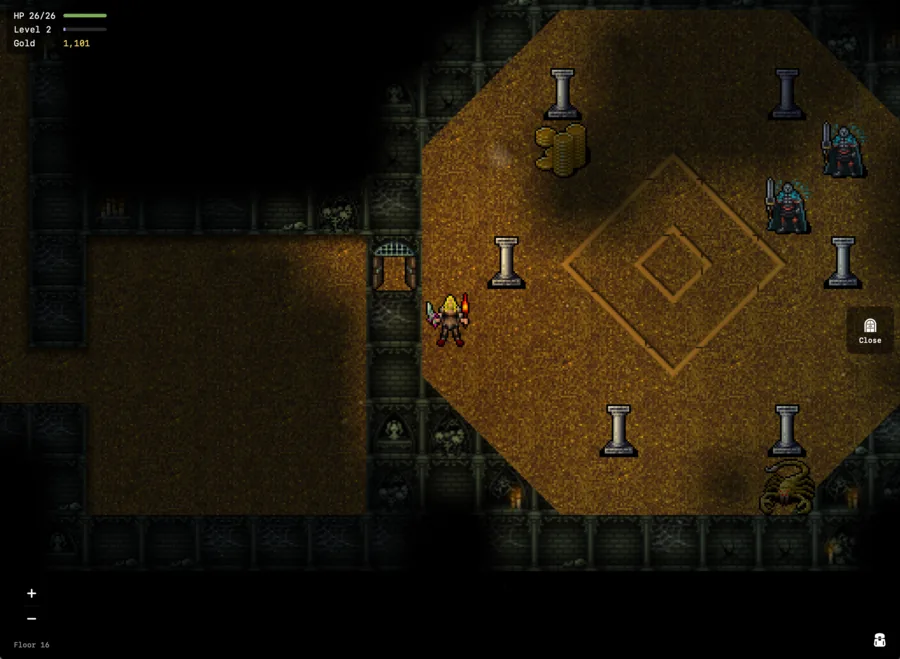
A colonnade sixteen floors down: pillars around a sigil cut into the floor, gold on the ground, two armed skeletons and a scorpion at the far side
⤢ Enlarge
They raised the Gravehoard to bury one dead king with his gold — and over the long centuries it grew, stone upon stone, floor beneath buried floor, into a barrow no one has found the bottom of, each age adding its own dead and its own treasure. The dead do not rest here. They wander, they hoard, and they wait.
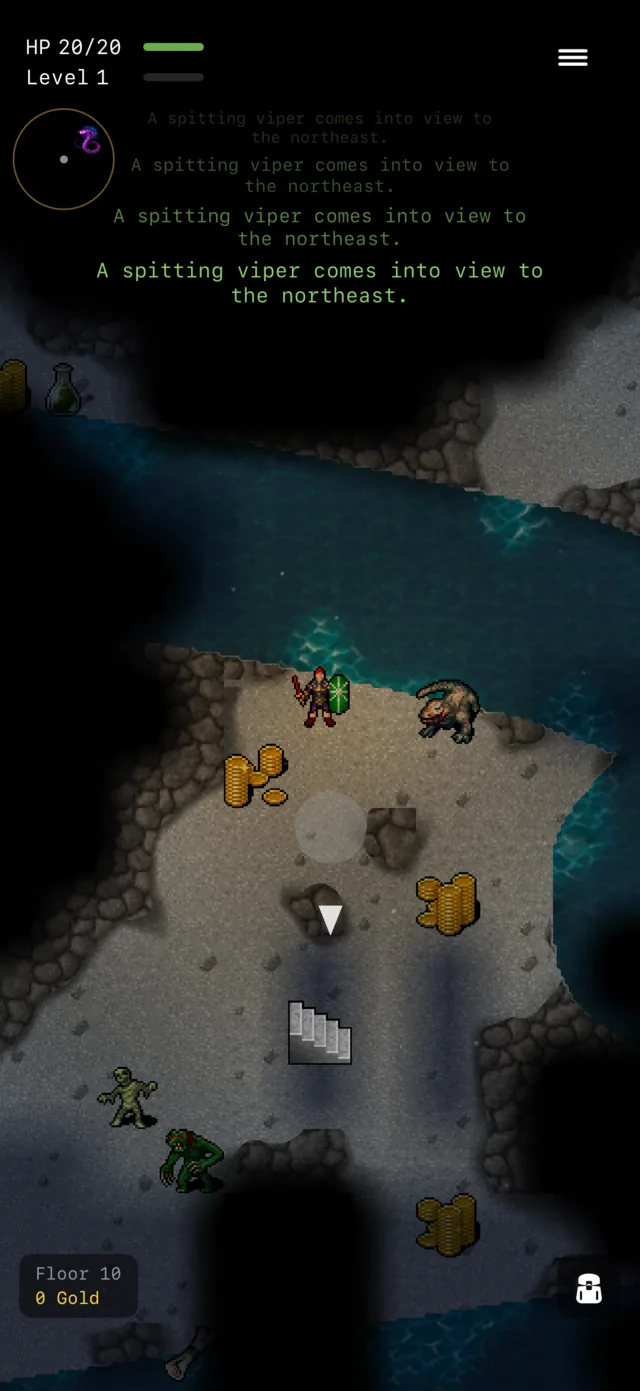
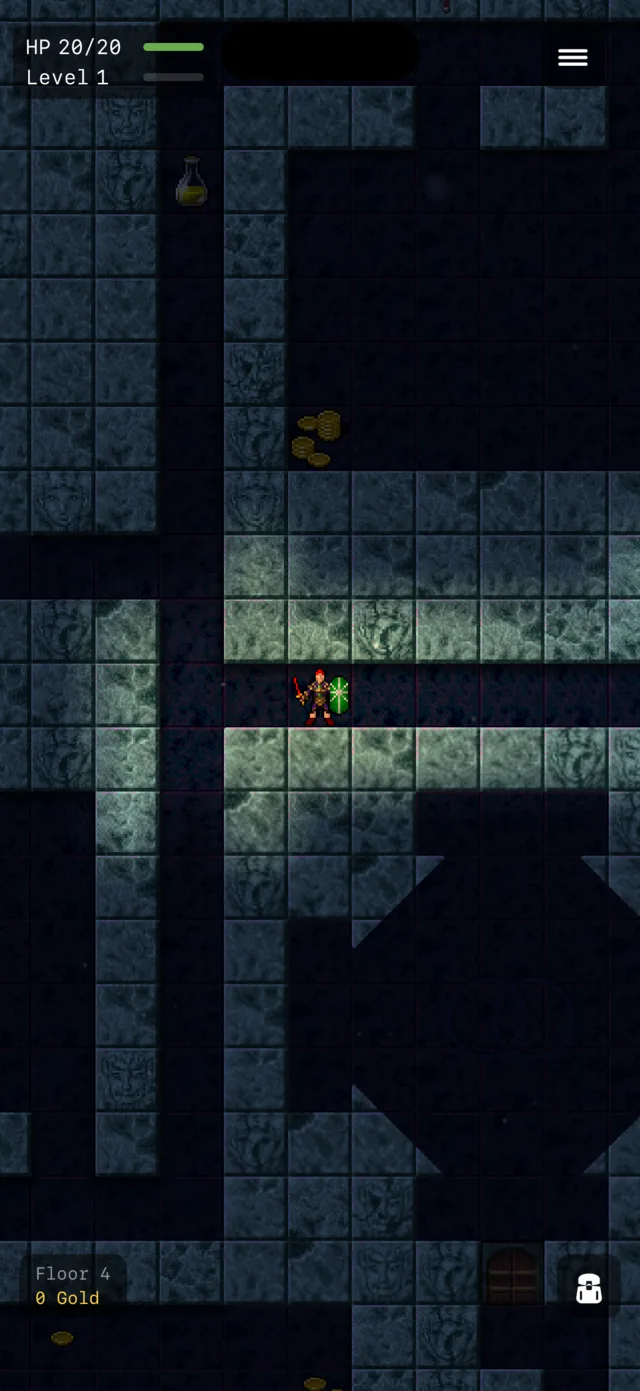
Gravehoard on iPhone mid-corridor, thumb down on the invisible eight-way pad
⤢ Enlarge
Your thumb lands, and that spot becomes the pad.

One hand, one thumb

Built for touch, not ported to it.

Hold your thumb anywhere on the screen and that spot becomes the center of an invisible eight-way pad — no virtual keypad, no tiny targets, nothing to hunt for. Movement and melee are the same gesture, wherever your hand happens to land. Shooting is the one thing that asks for a second tap.

  • Hold anywhere and lean the direction you want to go.
  • Flick to break into a run that carries on until something interesting stops it.
  • Double-tap a tile to travel there; pinch to zoom.
  • Walk into an enemy to attack it — melee asks for no button at all.
  • Shooting is two taps: Target takes the nearest enemy and cycles through the rest, Shoot looses it. Tap an enemy to retarget, tap bare ground to back out.
  • On the Mac, and on an iPad with a keyboard, drive it with keys and the mouse instead — t to target, f to fire, shortcuts for everything and required for nothing.
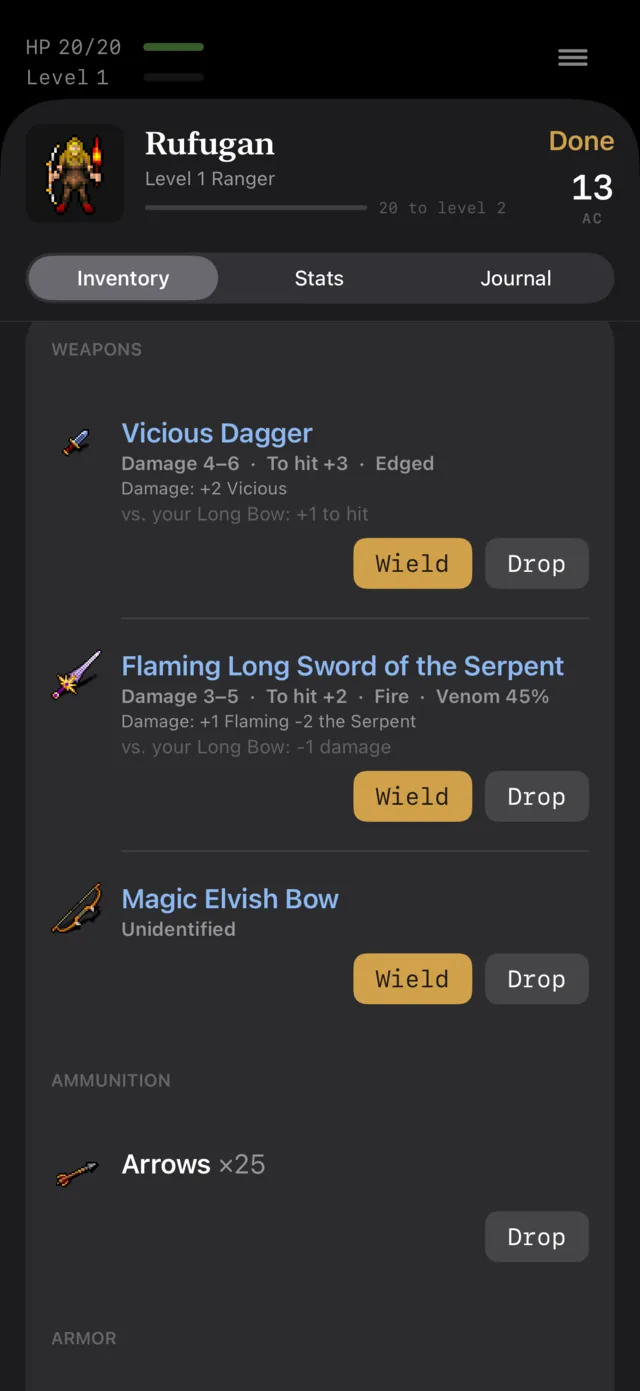
The Gravehoard pack: a Vicious Dagger and a Flaming Long Sword of the Serpent with their affixes itemized, and an unidentified Magic Elvish Bow below them
⤢ Enlarge
Flaming for fire, of the Serpent for venom — and it costs two damage.

The loot chase

A ring might be a fortune. Or a curse you can't take off.

Gear comes out of the dark unidentified, and the two possibilities look identical until you dare to put it on. Read a scroll, pay the Sage in town to do it properly, or just risk it. The uncertainty is the fun; a bigger number is not.

  • More than fifty base weapons and as many pieces of armor, with dozens of prefixes and suffixes that roll onto them — thousands of combinations, and two short swords are rarely the same short sword.
  • Those affixes are trades, not padding: Heavy hits harder and lands less often, Barbed turns your armor into a thing that bites back.
  • And every find is priced against what you're already holding — +1 to hit, −1 damage, printed on the card — so deciding what to carry out is reading, not arithmetic.
  • Then enchantment level, build quality, a curse, and the appearance rolled for your particular one, on top of all of it.
  • Two ring slots and an amulet, and none of the three carry any armor — an accessory is nothing but its affixes. Mighty for strength, of Frost Warding against a cold blow, of Regeneration if the dark is feeling generous.
  • The material is the kind, and it's plain to see — a Clay Ring near the top, an Iron Ring further down. What's hidden is the magic laid on your one, revealed the way a weapon's enchantment is.
  • More than eighty named legendaries, each with a history of its own — and the best of them a drawback to match.
  • A curse binds the piece to you — recoverable, but never for free.
  • Craftsmanship is real: a crude blade can shatter mid-swing, a masterwork one never will.
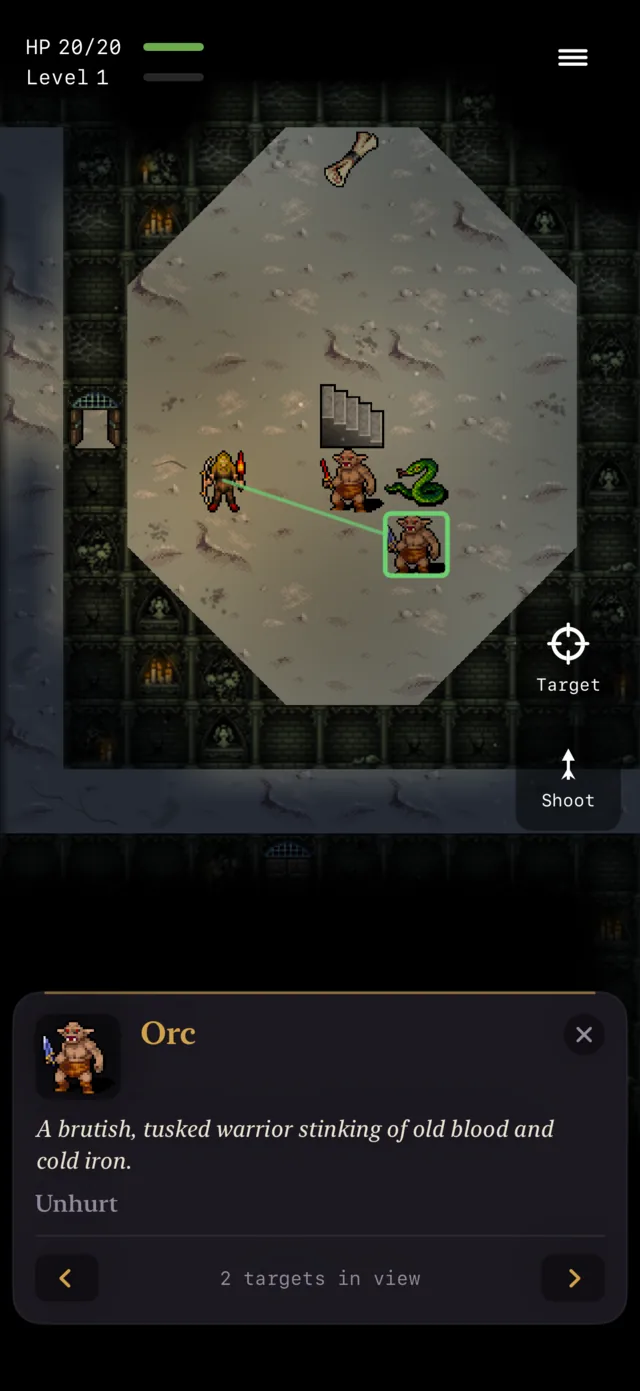
Gravehoard targeting a distant orc, a green line of fire running to the reticle while a second orc and an adder stand nearer
⤢ Enlarge
Not the nearest one — the one you chose.

Range

Aim once. It keeps aiming.

A Target button appears on the edge of the screen when — and only when — you're carrying something that shoots and there's an enemy in range of it. That's how every action button in the game works: there in the moment it's useful, gone the rest of the time, so there's no rail of controls to learn and nothing to switch off. And it opens on whatever you were shooting last, so long as that thing is still standing.

  • It holds your last target while that target lives, so working one enemy down is Shoot, Shoot, Shoot — no reacquiring between shots.
  • Changing your mind costs one tap: Target takes the nearest enemy and cycles outward through the rest by proximity, naming each one and how hurt it is as you pass over it.
  • Target and Shoot stay two separate buttons, so a tap meant to switch targets can never loose a shot by accident.
  • Ranged spells run through the same interface — learn it once and it works for a bow and a fireball alike.
  • Arrows are ammunition you buy, run out of, and pick back up off the floor — including the ones that were shot at you.
  • And it cuts both ways: enemy archers shoot back, which is what turned cover from decoration into a system.
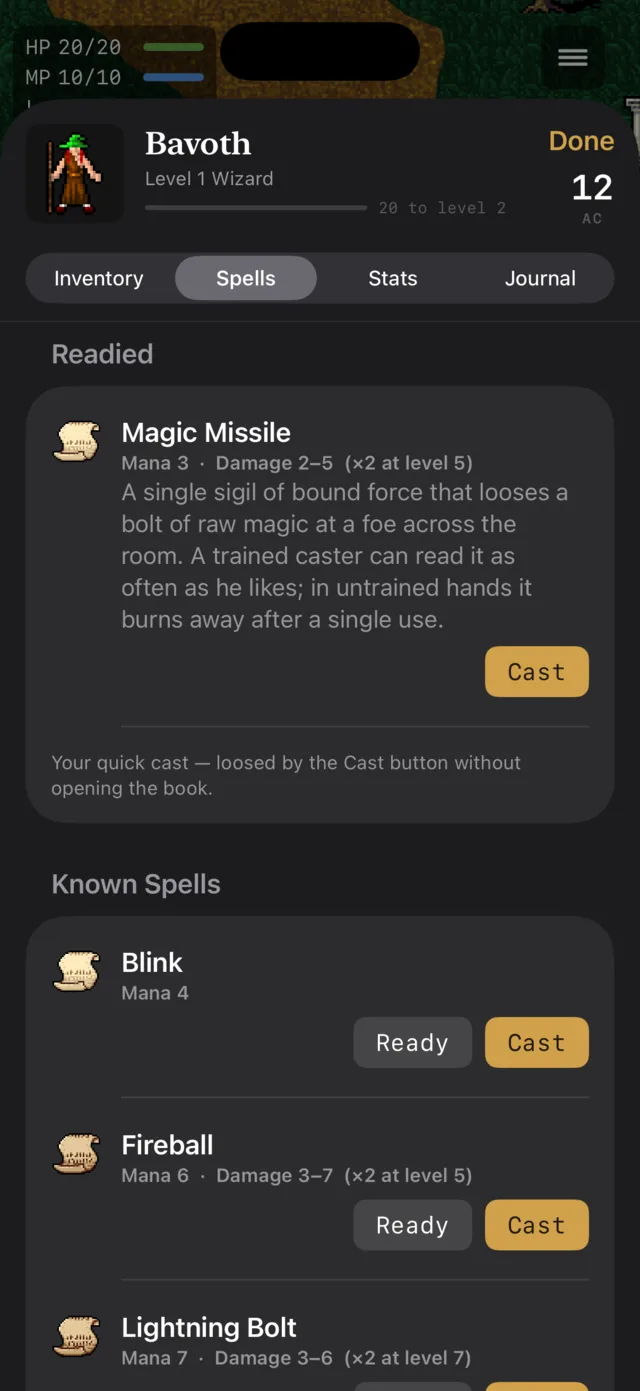
A Gravehoard spellbook: Magic Missile readied for quick casting, with Blink, Fireball and Lightning Bolt known, each priced in mana
⤢ Enlarge
Four spells in, ten floors to find the rest.

Magic

Eighteen spells, and you have to find them.

You start with a scroll or two and an empty book. Everything else your caster ever learns came up out of the dark, or off the Arcanum's shelf on a day it happened to be stocked. Read a scroll and the spell is yours for the rest of the run, paid for in mana every time you cast it — and anyone who isn't a caster gets exactly one reading out of that same page. Once it's in the book, mana is the only gate: no spell carries a level requirement, so if your pool covers the cost you can cast it, and if it doesn't, that's a number you can read before you commit rather than a stamp on the card.

  • Ten arcane and eight divine, in two schools that can't learn each other's — and no run hands you all of one, so two Wizards ten floors down are rarely carrying the same book.
  • Bolts, blasts with a radius, a lane that catches everything standing in it, wards you put on yourself, and mapping that hands you the floor.
  • Ready your workhorse spell and it casts straight from the main screen. The book is for the ones you reach for less often.
  • Depth is the real gate: Unmaking is a floor-sixteen spell and it does not turn up on floor two.
  • The Cleric's list is shorter and much better at keeping him alive; the Wizard's is the widest below and gets him killed.
  • And some things down there cast back — darkness, confusion, a coil that holds you where you stand, and healers who mend the pack you were most of the way through.
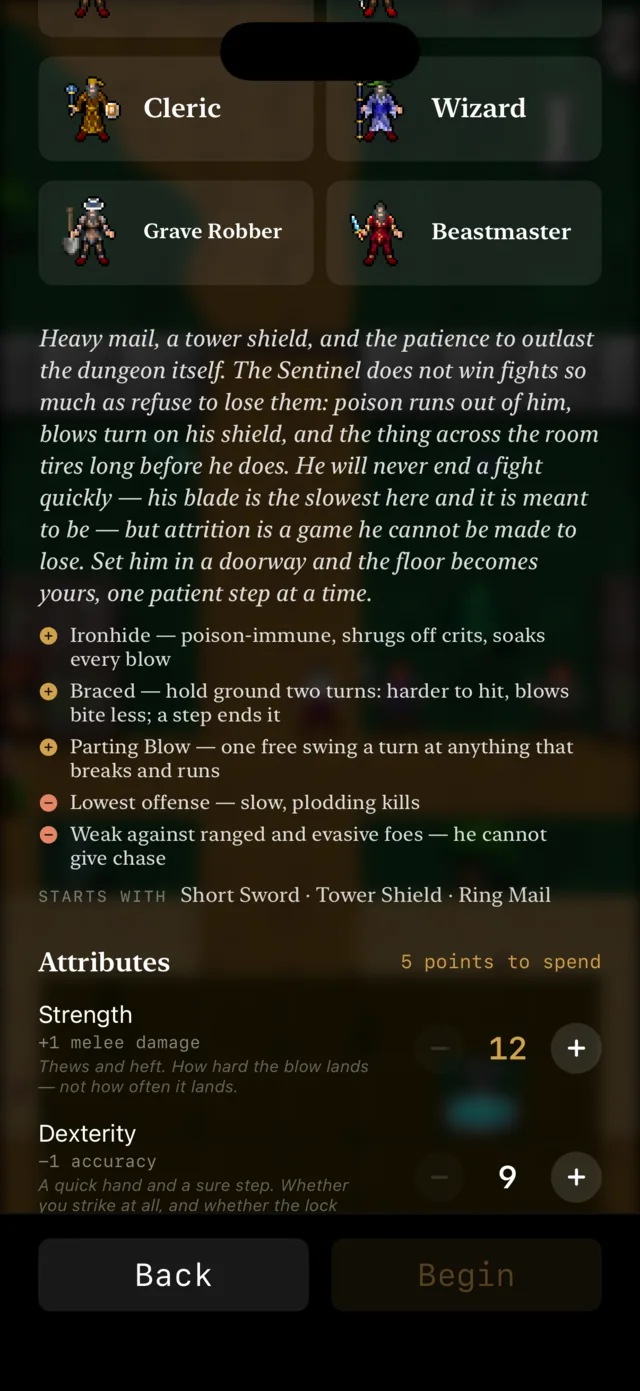
Gravehoard character creation: the Sentinel's card, three boons and two banes listed with its starting kit
⤢ Enlarge
Boons and banes, printed before you commit.

Ten ways in

Ten classes that play like ten different games.

Every one of them carries named boons and named banes, printed on the character sheet where you can read them before you commit. They are not a spread of stat modifiers over the same adventurer — a Sentinel and a Wizard want different floors, different fights, and different loot out of the same barrow, and neither one can play the other's run.

The Fighter

Master-at-arms — a flat bonus to hit and to damage with any weapon he picks up, so no found blade is ever wasted on him.

And no fortune at all — twice the fumbles, twice the crits taken, thinner loot — and no system of his own: no magic, no bow, no locks.

The Barbarian

The biggest hit on the roster at every armor class, and the hit points to stand there swinging — with a two-hander that crits three times as often and comes round wide enough to catch more than one of them.

And he misses often, can't carry a shield, and wears the thinnest hide in melee.

The Sentinel

Shrugs off poison and crits, braces to make himself harder to hit and blunt what lands anyway, and takes a free swing at anything that breaks and runs — set him in a doorway and the floor becomes yours.

And has the slowest kill on the roster, with no way to chase what keeps its distance.

The Rogue

Has the quietest tread on the roster and puts a dagger in an unwary back for triple damage, with the surest hand for locks, pressure plates, and thrown blades.

And he is frail and lightly armored, and loses any fight that lasts.

The Ranger

Opens the fight across the room, and reads the floor well enough to notice what the others blunder into.

And is weak up close, lightly armored, and only as dangerous as his last quiver.

The Cleric

Inscribes a prayer rather than spending it and casts it for mana ever after, closes his own wounds and burns out his own poison without potion or Healer, and rebukes the barrow's dead with something they have no answer for — every corpse in sight breaks.

And swings blunt or swings badly, with a modest ceiling either way.

The Wizard

A scroll anyone else burns once becomes a page he casts forever, and his is the widest repertoire in the game — ten spells to divine's eight, and the only ones that catch a whole room — with mana that rises every level and gear no other class can use.

And dies the moment something reaches him, handles a weapon badly, and has a very short story once the mana runs dry.

The Vagabond

Starts with a purse instead of a weapon, is welcome at every counter in town and pays less at all of them, and runs on Luck alone — including the one Luck buys that nobody else gets: surviving a killing blow.

Which is either the best or the worst run you will have.

The Grave Robber

Wears cursed gear and takes it off again, prices a find where it lies, robs the dead of what they were buried with, and reads a trap before it reads him.

And every counter in town shuns him for what he does for a living.

The Beastmaster

Tames a beast and gives it standing orders — hold it at heel, where it never loses its nerve, or send it ranging ahead to scout, where it widens what you can see — and he feels animals through stone, cows a wild one into breaking, and tames another when his own falls.

And none of it counts against the undead and constructs of the deep floors.

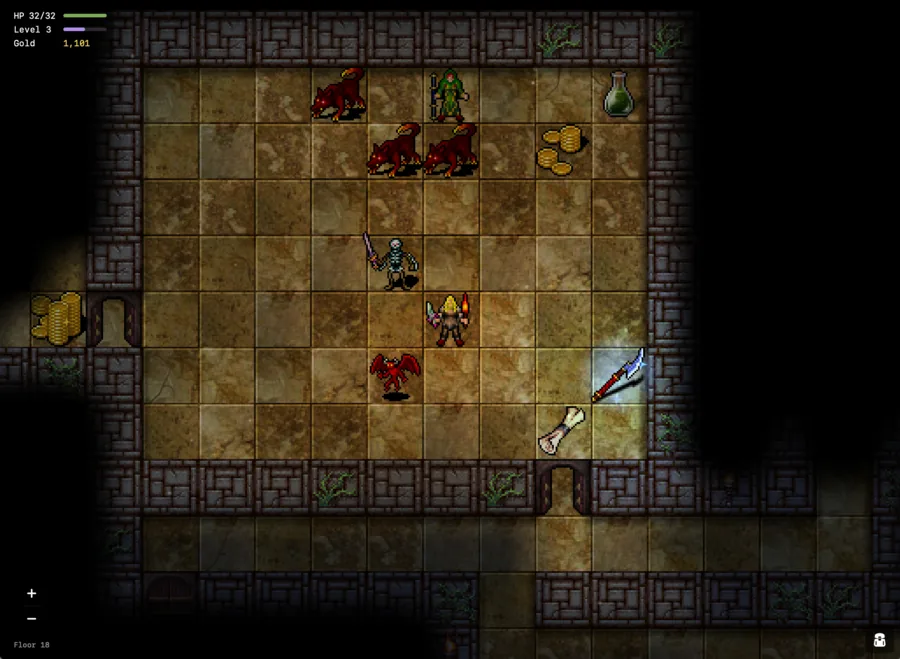
Floor eighteen: three hounds and a robed figure at the far wall, a sword-bearing skeleton closing, and a winged thing already past you
⤢ Enlarge
Six of them, and not one is doing the same thing.

Things that want to live

Nothing down here is just walking toward you.

An enemy is asleep, or awake but not paying attention, or actually hunting you — and those are three different things. You see across a room; something that hasn't noticed you doesn't. That gap is where the stealth game lives, and closing it is usually your own fault.

  • Creeping quiets your footsteps and does nothing whatsoever about your armor.
  • A fight is loud, and it carries further than a footstep and through stone.
  • Wounded things lose their nerve and give ground; packmates steady each other.
  • Archers back off to reopen their range, and come at you through cover when you shoot.
  • Block a doorway and it helps — but whatever can't reach you comes around rather than waiting its turn.
  • Lose something in the dark and it searches where it last saw you, not where you actually are.
  • Sixty-one kinds, and a hundred and thirty-two distinct foes once the deeper ones turn up ranked — a Veteran or a Champion among the humanoids, a Dire wolf or a Giant adder, an Elder or an Ancient among the dead.
  • The higher ranks hold a band together, so killing the leader first is a decision rather than a habit.
  • And the top of that ladder is a person, not a bigger number. Every Champion and every Ancient carries a name, a face, and an entry in your Foes list afterward — gold-marked in the room, and about one a floor down in the lower barrow.
  • A name needs somebody to have been, so the barrow remembers its draugr and its death knights and never its skeletons. Beasts stay anonymous too: a wolf holding its pack together is doing its job, not making a name for itself.
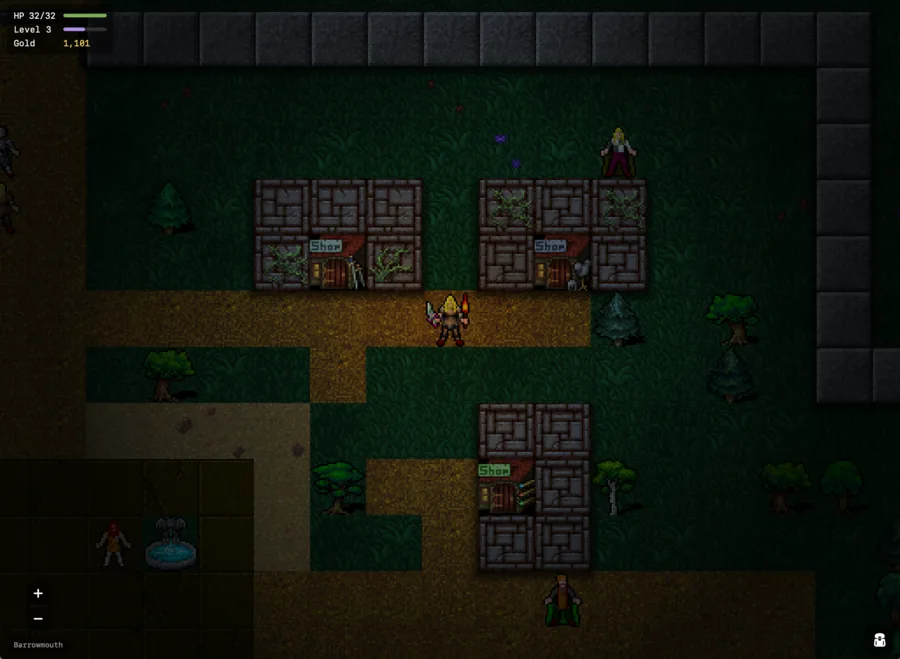
Barrowmouth after dark: three lit shopfronts along the path, townsfolk out on the grass, and the fountain court below
⤢ Enlarge
Barrowmouth after dark — the town keeps its own hours.

Barrowmouth

The town is the bank.

Climb out with what you can carry and there are seven counters waiting for it, each holding to a strict trade and each with a purse that runs dry. Sell, identify, repair, drink, sleep, and go back down a little better armed.

  • Sundries keeps you in arrows and tools. The Arcanum has the potions, the scrolls, and the jewelry.
  • The Sage identifies what you found, and lifts what has stuck to you.
  • The Smith takes steel and the Armorer takes harness — and both mend what the dark broke.
  • The Healer sells nothing at all: she mends what the barrow did to you, and purges what it left in you.
  • The Tavern sells drinks, a bed for the night, and rumors about the floors below.
  • Prices move with what's on the shelf. A counter short of a thing pays well for one; sell him three swords and he barely wants your fourth — and he'll tell you what he's short of.
  • None of that is a simulation running out of sight. What he'll pay is readable off the goods in front of you, which is the only way price memory is any use in a ten-minute visit.
  • Stock rotates overnight, and the town has a night: the sun rises and sets on your own turn count.
A dressed room deep in the Gravehoard, wall torches casting shadows into fog
⤢ Enlarge
Torchlight, cast shadows, and fog closing at the edge of sight.

A place, not a stack of levels

Twenty floors, and every one of them persists.

Climb back up and a floor is as you left it — explored, looted, and carried on without you, with whatever has wandered in behind you. Floors come in visual bands two to four deep, so the walls changing is an event rather than a texture swap.

  • Four layout families — rooms and corridors, natural caverns, great halls, and tangle.
  • Rooms with a purpose: a colonnade, a shrine, a graveyard, a fountain court, a sealed store room.
  • Water you wade through, and deeps only some things will cross.
  • Secret doors, hidden traps, and locked chests you can pick, bash, or open with a scroll.
  • Loot you left behind may be picked up and carried off by something that moved in after you.
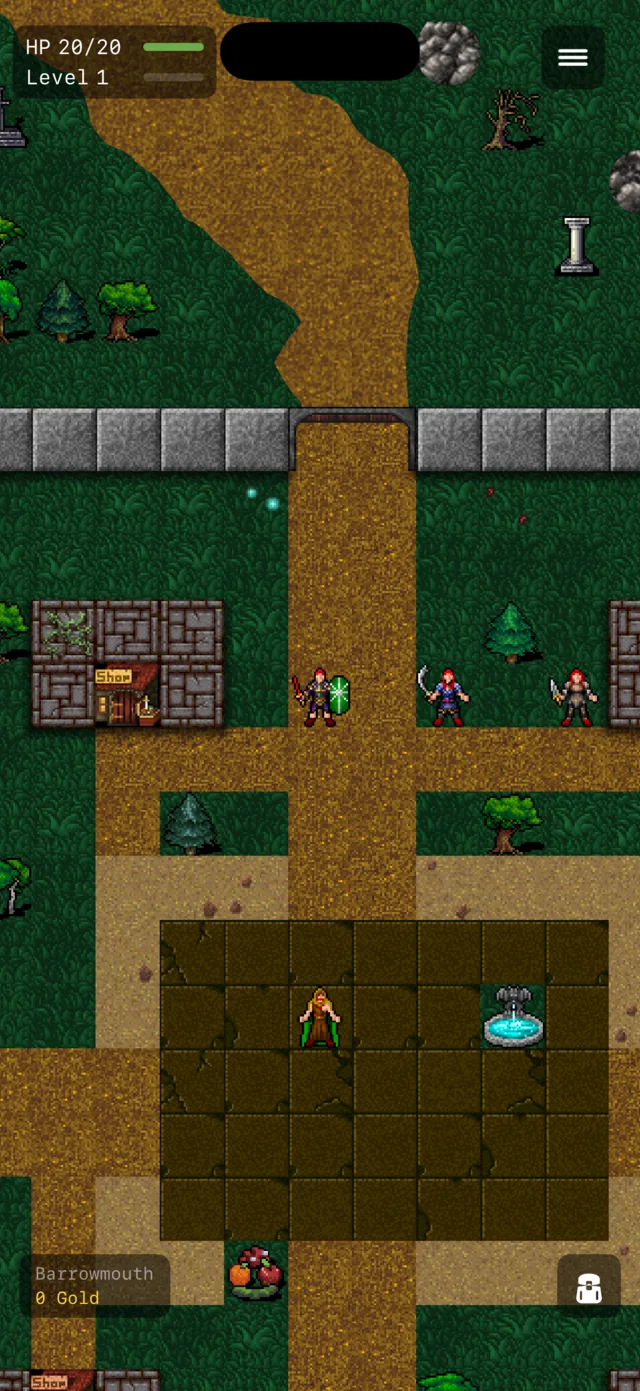
Back on your feet in Barrowmouth: the shop, townsfolk at the crossroads, the fountain court, and the barrow's mouth in the wall to the north
⤢ Enlarge
Back in Barrowmouth, with your pack still on floor four.

Two rules, and you pick one

Death costs the foray, not the character.

Standard is the default: you wake up in Barrowmouth keeping your level, what you learned, and the gear you were wearing, while your pack stays in a pile on the floor you fell on — still there, still slowly filling back up, while you decide whether to go down and get it. Hardcore is the old rule, and it means what it has always meant: you die once and that character is gone — no recovery, no pack to go back for, nothing to do but start again. It's opt-in, and badged wherever the game records what you did.

  • No meta-progression in either mode — Standard doesn't make you stronger for dying, it just declines to delete you.
  • A run autosaves as you go and spans as many sessions as it takes — play twenty minutes and come back Tuesday.
  • And it follows you across devices over iCloud: stop mid-floor on the Mac, open the phone on the train, and the same character is standing where you left him. Nothing to export, nothing to lose.
  • Three difficulty settings, fixed when you make the character.
  • Luck is a real attribute, and one of the things it buys is a chance to survive a killing blow.

Everything the old games had. None of the homework.

The depth and weight of the old heavy roguelikes, with the affordances of a modern app.

It keeps the teeth

One character a run, every floor generated fresh, loot you can't identify, and combat slow enough that a single bad decision is the whole fight. Death is a real setback by default — and if you want it to be the end, that's a switch you throw yourself.

It doesn't make you study

Nothing you have to memorize before you start — the buttons you're offered are the ones this tile can actually do, and they're named for what they'll do to it. There are keyboard shortcuts when you want them, and you never need one.

It goes where you go

A run autosaves and syncs over iCloud, so the character you were playing on the Mac is the one waiting on your phone.

It looks like something

Sprites, torchlight, cast shadows, drifting dust, and fog that closes at the edge of sight, in a genre that spent thirty years drawn in punctuation.

The upper barrow is free. And you can win it.

Not a trial and not a timer — ten of Gravehoard's twenty floors, four of its ten classes, and a whole game with an ending of its own. Here's how it will be priced when it ships. The TestFlight beta is free, and while it runs testers play the whole thing — both barrows, all ten classes.

The upper barrow, free forever

Ten floors and four classes to walk them — the Fighter, the Sentinel, the Rogue, and the Wizard — with Barrowmouth and its whole economy above. Every difficulty, both death rules, every save slot, iCloud sync across your devices, and nothing in it that expires. It ends the way it should: a golden chest in the deepest room of the upper barrow, a named legendary inside it, and a climb back up into daylight carrying the thing. Get it home and the barrow is yours, and the records say so.

$7.99 opens the lower barrow

Ten more floors under the ones you cleared, meaner the whole way down, and the Barrow-King's Crown at the bottom of them — the ending nobody has carried out yet. Six more classes: the Barbarian, the Ranger, the Cleric, the Vagabond, the Grave Robber, and the Beastmaster. Keep the character you already earned, and take that legendary down with you. One purchase covers iPhone, iPad, and Mac — every device you own, and up to five family members on theirs.

And never anything else

No ads. No subscription. No timed trial, no energy meters, no soft currency, nothing consumable, nothing to buy a second time. You pay once, or you don't, and either way that's the end of it.

Get on the list. Get into the beta.

Gravehoard is in beta now on TestFlight, for iPhone, iPad, and Mac — playable start to finish, and still being built. Leave your email and I'll send you the invite.

The upper barrow free, forever, ending and all. $7.99 opens the lower barrow — one purchase, three platforms, your whole family.

Join the waitlist

Gravehoard is made by one person, full time, in Austin, Texas.